This expanded marketing plan for "The Nazareth
Manifest" is the definitive strategic directive of the Office of
Faith, Justice, and Humanitarian Efforts (OFJHE). It serves to unify the
Independent Sacramental Movement (ISM) by bridging the gap between historical
apostolic authority and modern liberationist action.
THE NAZARETH MANIFEST: PHASE ONE STRATEGIC
MARKETING PLAN
I. Executive Summary: The Core Proposition
The Nazareth Manifest is the inaugural operational
directive of the OFJHE. It is rooted in the "Ancient Liberty"
of the Church of Utrecht and propelled by the "Nazarene Manifesto"
(Luke 4:18-19). This plan transforms the Diocese from a reactive religious body
into a proactive vessel for immigrant survival and social reform. The core
message is: "Ancient Roots. Modern Resistance. Your Apostolic Right to
Liberate". This narrative frames social activism not as a modern
political innovation but as a preservation of an ancient heritage. By
identifying those fleeing violence and poverty as the "Anawim"
or "the least of these," the mission becomes a sacred command to
"welcome the stranger".
II. Strategic Strengths and Weaknesses
A. Strengths
- Deep
Value Alignment: By framing humanitarian missions as an "Apostolic
Right," the campaign provides a powerful psychological lever for
ISM leaders.
- Tangible
"Praxis": The strategy moves from abstract
theory to concrete survival mechanics, such as the Promotoras de Salud
(community health) model.
- Diverse
Outreach: The plan utilizes a multi-channel
approach, moving beyond digital silos into physical "Justice
Cafés" and secure channels like WhatsApp and Signal.
- Theological
Integrity: The integration of Bishop Greer’s
liturgical series ensures the activism feels spiritually legitimate and
grounded in prayer.
B. Weaknesses
- Risk
of Over-Intellectualization: There is a heavy
reliance on academic concepts like the Concordat of Worms and De
Antiqua Libertate, which may alienate those focused on practical
action.
- Resource
Strain: The implementation of such a broad
multi-channel campaign could strain a small volunteer team without
prioritized resource planning.
- Operational
Complexity: The extended 42-day rollout
requires high-level coordination and constant monitoring to avoid
messaging fatigue.
III. Six-Week Tactical Roadmap (The Extended
Rollout)
The campaign is divided into three distinct phases over 42
days (6 weeks) to ensure maximum relationship-building and participation.
Weeks 1–2: Stage A – The
"Tree-Shaking" Phase (Awareness)
This phase aims to identify ready participants through a
staged marketing effort.
- Digital
Tactics: Launch provocative graphics and
high-impact visuals (e.g., "Unidos en Arizona") on
Instagram and TikTok to trigger immediate community interest.
- Offline
Tactics: Partner with local parishes to distribute
"Emergency Call" flyers and "Quick Guides"
to build initial awareness.
- Goal:
To identify a "Second Tier" of dedicated leadership ready
to assume moderate-to-high levels of responsibility.
Weeks 3–5: Stage B – The "Call to the
Upper Room" (Deep Engagement)
The focus shifts to private messaging and deeper personal
invitations to build trust.
- Justice
Cafés: Host informal meetups at local coffee
shops or parish halls to facilitate open discussion on faith and social
justice.
- Social
Justice Film Nights: Screen documentaries like "From
Utrecht to Arizona" followed by group discussions to connect film
themes to the ISM's apostolic mission.
- Faith
in Action Toolkits: Offer hands-on workshops teaching
practical skills like Power of Attorney and community health
advocacy.
- Goal:
Secure webinar registrations and drive attendees from passive learners to
active participants through personal follow-ups.
Week 6: The "Operation Nazareth"
Webinar & Conversion (Action)
The culmination of the campaign is the "Operation
Nazareth" webinar.
- The
Training: Virtual "Live Meeting Rooms"
provide tactical training in building grassroots bases.
- Conversion:
The webinar series transforms attendees into "active
stewards" of a protective digital ecosystem for vulnerable
populations.
- Goal:
Solidify the "Second Tier" leadership and finalize the
pairing of "Guardian" and "Beneficiary" families
through a Covenant of Solidarity.
IV. Content Pillars and Messaging
The strategy rests on three theological anchors that
reinforce the connection between faith and action:
1.
The Liturgical Call:
Utilizing Bishop Greer’s eight-week Liturgical Series (May 31 – July 19,
2026) to provide homily directions and intercessions focused on immigrant
accompaniment.
2.
The Rights Defense:
Creating easy-to-read "Quick Guides" on the Concordat of
Worms and ISM autonomy to empower clergy in political engagement.
3.
The Praxis Workshop:
Highlighting modern community health and advocacy efforts, using testimonials
from those who have successfully combined tradition with activism.
V. The Role of Convergent Streams Magazine
Convergent Streams
serves as the "Beacon" of the project’s public evangelization.
- Veritas
Manifesta Project: The magazine is the primary vehicle
for making truth visible in a world darkened by misinformation.
- Integrated
Theme: The Q3 2026 edition focuses on "Immigration,
Belonging, and the Work of Peace," creating a unified front with
the Liturgical Series and Daily Devotionals.
- Theology
of Presence: Content will emphasize that the immigrant
is not a problem to be managed but a person to be accompanied.
- Actionable
Content: Digital hubs must be fueled by
high-quality theological content to counter false narratives regarding
"open borders".
VI. Operational Goals and Success Metrics
To ensure accountability, the OFJHE will monitor the
following Phase One metrics:
- Network
Reach: Tracking analytics for impressions and
engagements across the public and secure digital hubs.
- Covenant
Completion: Measuring the number of successfully
paired families under the Covenant of Solidarity.
- Hardware
Deployment: Auditing the refurbishment and
distribution of donated laptops and printers to ensure every family can
access the secure network.
- Feedback
Loops: Gathering direct input from the "Second
Tier" leadership to adapt strategies to changing ground
conditions.
VII. Understanding the Context of
Institutionalized Sin
Institutionalized Sin
refers to systemic injustices or harmful practices embedded within social,
political, or religious institutions, rather than being limited to individual
wrongdoing.
- In
the context of the Nazareth Manifest, understanding Institutionalized
Sin is a key outcome measured in post-webinar surveys, underscoring
its importance to the campaign's educational and activist goals.
- The
campaign frames activism against such systemic injustices as an "Apostolic
Right," encouraging participants to recognize and address these
broader, structural forms of harm.
- Example:
The strategy connects Institutionalized Sin to issues such as
unfair economic systems and current enforcement tactics by ICE, which are
viewed as manifestations of sin.
- The
mission urges faith-based communities to respond not just to individual
needs but to challenge the systems that perpetuate hunger and injustice.
- In
summary, within this campaign, Institutionalized Sin is understood
as the collective, ongoing wrongs perpetuated by institutions, requiring
both awareness and active resistance from faith-based activists.
VIII. Tactical Roadmap for Parish Leadership
Parishes will serve as "Field Hospitals"
and tactical defense hubs. Leadership cores must follow a two-pronged approach:
- Immigrant
Sector: Discretion-heavy focus on organizing
vital documents and organizing "Go-Bags" with extreme caution to
prevent state surveillance.
- Citizen
Sector: Public-facing focus on advocacy, legal
mentorship, and resource sharing to act as a "Shield" for the
undocumented.
IX. Feasibility Assessment
The Scale: 8/10 (Reasonable Chance to Succeed)
"The Nazareth Manifest" has a
strong probability of success for the following reasons:
1.
Value Alignment: It
validates social activism as a spiritual right, providing a unique and
high-value incentive for ISM progressives.
2.
Timeliness: The
focus on the 2026 global displacement crisis and loooming local crises
creates a natural "urgency hook" that drives community interest.
3.
Practical Utility: By
prioritizing "Praxis over Pedagogy," the campaign provides
immediate, tangible value through health toolkits and legal protections, moving
beyond abstract lectures.
Conditions for Success: To
maintain this rating, the project must avoid "scope creep" and
ensure that messaging remains accessible to the laity, not just the clergy.
Provided the Phase One digital infrastructure is secured and the "Second
Tier" leadership is identified, this plan will successfully transform
passive learners into an empowered, organized front for liberation.
Soli
Deo Gloria. Pax et Bonum.
EL MANIFIESTO DE NAZARET: PLAN DE MARKETING
ESTRATÉGICO DE LA FASE UNO
I. Resumen Ejecutivo: La Propuesta Central
El Manifiesto de Nazaret es la directiva operativa
inaugural de la OFJHE. Está arraigado en la "Antigua Libertad" de la
Iglesia de Utrecht y es impulsado por el "Manifiesto Nazareno" (Lucas
4:18-19). Este plan transforma a la Diócesis de ser un cuerpo religioso
reactivo a convertirse en un vehículo proactivo para la supervivencia de los
inmigrantes y la reforma social.
El mensaje central es: "Raíces Antiguas.
Resistencia Moderna. Su Derecho Apostólico a Liberar". Esta narrativa
enmarca el activismo social no como una innovación política moderna, sino como
la preservación de una herencia antigua. Al identificar a quienes huyen de la
violencia y la pobreza como los "Anawim" o "los más
pequeños", la misión se convierte en un mandato sagrado para "acoger
al forastero".
II. Fortalezas y Debilidades Estratégicas
A. Fortalezas
- Alineación
Profunda de Valores: Al enmarcar las misiones
humanitarias como un "Derecho Apostólico", la campaña
proporciona una poderosa palanca psicológica para los líderes del ISM.
- "Praxis"
Tangible: La estrategia pasa de la teoría abstracta
a los mecanismos concretos de supervivencia, como el modelo de las
Promotoras de Salud (salud comunitaria).
- Alcance
Diverso: El plan utiliza un enfoque multicanal,
yendo más allá de los silos digitales hacia "Cafés de Justicia"
físicos y canales seguros como WhatsApp y Signal.
- Integridad
Teológica: La integración de la serie litúrgica del
Obispo Greer asegura que el activismo se sienta espiritualmente legítimo y
fundamentado en la oración.
B. Debilidades
- Riesgo
de Sobre-Intelectualización: Existe una fuerte
dependencia de conceptos académicos como el Concordato de Worms y De
Antiqua Libertate, que pueden distanciar a quienes están enfocados en
la acción práctica.
- Tensión
de Recursos: La implementación de una campaña
multicanal tan amplia podría tensionar a un equipo pequeño de voluntarios
sin una planificación de recursos priorizada.
- Complejidad
Operativa: El despliegue prolongado de 42 días
requiere una coordinación de alto nivel y un monitoreo constante para
evitar la fatiga del mensaje.
III. Hoja de Ruta Táctica de Seis Semanas (El
Despliegue Prolongado)
La campaña se divide en tres fases distintas a lo largo de
42 días (6 semanas) para garantizar la máxima construcción de relaciones y
participación.
Semanas 1-2: Etapa A - La Fase de "Sacudir
el Árbol" (Concienciación)
Esta fase tiene como objetivo identificar a los
participantes listos a través de un esfuerzo de marketing escalonado.
- Tácticas
Digitales: Lanzar gráficos provocativos y recursos
visuales de alto impacto (por ejemplo, "Unidos en Arizona") en
Instagram y TikTok para activar el interés inmediato de la comunidad.
- Tácticas
Fuera de Línea: Asociarse con las parroquias locales para
distribuir volantes de "Llamado de Emergencia" y "Guías
Rápidas" para construir la concienciación inicial.
- Objetivo:
Identificar un "Segundo Nivel" de liderazgo dedicado, listo para
asumir niveles de responsabilidad moderados a altos.
Semanas 3-5: Etapa B - El "Llamado al
Cenáculo" (Compromiso Profundo)
El enfoque cambia hacia la mensajería privada y las
invitaciones personales más profundas para generar confianza.
- Cafés
de Justicia: Organizar encuentros informales en
cafeterías locales o salones parroquiales para facilitar una discusión
abierta sobre la fe y la justicia social.
- Noches
de Cine de Justicia Social: Proyectar documentales
como "De Utrecht a Arizona", seguidos de discusiones grupales
para conectar los temas del filme con la misión apostólica del ISM.
- Kits
de Herramientas de Fe en Acción: Ofrecer talleres
prácticos que enseñen habilidades concretas como Poderes Notariales (Power
of Attorney) y la defensa de la salud comunitaria.
- Objetivo:
Asegurar los registros al seminario web (webinar) e impulsar a los
asistentes de ser estudiantes pasivos a participantes activos a través de
seguimientos personales.
Semana 6: El Seminario Web "Operación
Nazaret" y Conversión (Acción)
La culminación de la campaña es el seminario web
"Operación Nazaret".
- La
Capacitación: Las "Salas de Reuniones en
Vivo" virtuales proporcionan capacitación táctica para construir
bases comunitarias.
- Conversión:
La serie de seminarios web transforma a los asistentes en "custodios
activos" de un ecosistema digital protector para las poblaciones
vulnerables.
- Objetivo:
Solidificar el liderazgo del "Segundo Nivel" y finalizar el
emparejamiento de familias "Protectoras" y
"Beneficiarias" a través de un Pacto de Solidaridad.
IV. Pilares de Contenido y Mensajería
La estrategia se apoya en tres anclajes teológicos que
refuerzan la conexión entre la fe y la acción:
1.
El Llamado Litúrgico:
Utilizar la Serie Litúrgica de ocho semanas del Obispo Greer (31 de mayo - 19
de julio de 2026) para proporcionar las direcciones de las homilías e
intercesiones enfocadas en el acompañamiento de los inmigrantes.
2.
La Defensa de los Derechos: Crear
"Guías Rápidas" fáciles de leer sobre el Concordato de Worms y la
autonomía del ISM para empoderar al clero en el compromiso político.
3.
El Taller de Praxis:
Destacar los esfuerzos modernos de salud comunitaria y defensoría, utilizando
testimonios de quienes han combinado con éxito la tradición con el activismo.
V. El Rol de la Revista Convergent Streams
Convergent Streams sirve
como el "Faro" de la evangelización pública del proyecto.
- Proyecto
Veritas Manifesta: La revista es el vehículo principal
para hacer visible la verdad en un mundo oscurecido por la desinformación.
- Tema
Integrado: La edición del tercer trimestre (Q3) de
2026 se enfoca en "Inmigración, Pertenencia y la Obra de la
Paz", creando un frente unificado con la Serie Litúrgica y los
Devocionales Diarios.
- Teología
de la Presencia: El contenido enfatizará que el inmigrante
no es un problema a ser administrado, sino una persona a ser acompañada.
- Contenido
Procesable: Los centros digitales deben ser
alimentados con contenido teológico de alta calidad para contrarrestar las
falsas narrativas respecto a las "fronteras abiertas".
VI. Objetivos Operativos y Métricas de Éxito
Para garantizar la rendición de cuentas, la OFJHE
monitoreará las siguientes métricas de la Fase Uno:
- Alcance
de la Red: Seguimiento de analíticas para
impresiones e interacciones a través de los centros digitales públicos y
seguros.
- Cumplimiento
del Pacto: Medir el número de familias emparejadas
con éxito bajo el Pacto de Solidaridad.
- Despliegue
de Hardware: Auditar la restauración y distribución de
computadoras portátiles e impresoras donadas para asegurar que cada
familia pueda acceder a la red segura.
- Circuitos
de Retroalimentación: Recopilar comentarios directos del
liderazgo del "Segundo Nivel" para adaptar las estrategias a las
condiciones cambiantes del terreno.
VII. Entendiendo el Contexto del Pecado
Institucionalizado
- El
Pecado Institucionalizado se refiere a las injusticias sistémicas o
prácticas dañinas incrustadas dentro de las instituciones sociales,
políticas o religiosas, en lugar de limitarse a las malas acciones
individuales.
- En
el contexto del Manifiesto de Nazaret, la comprensión del Pecado
Institucionalizado es un resultado clave medido en las encuestas
posteriores al seminario web, subrayando su importancia para los objetivos
educativos y activistas de la campaña.
- El
plan enmarca el activismo contra tales injusticias sistémicas como un
"Derecho Apostólico", alentando a los participantes a reconocer
y abordar estas formas de daño estructurales y más amplias.
- Ejemplo:
La estrategia conecta el Pecado Institucionalizado con problemas tales
como los sistemas económicos injustos y las tácticas actuales de control
por parte de ICE, los cuales son vistos como manifestaciones del pecado.
- La
misión insta a las comunidades basadas en la fe a responder no solo a las
necesidades individuales, sino a desafiar los sistemas que perpetúan el
hambre y la injusticia.
En resumen, dentro de esta campaña, el Pecado
Institucionalizado se entiende como los males colectivos y continuos
perpetuados por las instituciones, lo que requiere tanto concienciación como
una resistencia activa por parte de los activistas basados en la fe.
VIII. Hoja de Ruta Táctica para el Liderazgo
Parroquial
Las parroquias servirán como "Hospitales de
Campaña" y centros tácticos de defensa. Los núcleos de liderazgo deben
seguir un enfoque de dos vías:
- Sector
Inmigrante: Enfoque de alta discreción centrado en
organizar documentos vitales y preparar "Mochilas de Emergencia"
(Go-Bags) con extrema precaución para evitar la vigilancia estatal.
- Sector
Ciudadano: Enfoque de cara al público centrado en la
defensa, la tutoría legal y el intercambio de recursos para actuar como un
"Escudo" para los indocumentados.
IX. Evaluación de Viabilidad
La Escala: 8/10 (Probabilidad Razonable de
Éxito)
"El Manifiesto de Nazaret" tiene una fuerte
probabilidad de éxito por las siguientes razones:
1.
Alineación de Valores:
Valida el activismo social como un derecho espiritual, proporcionando un
incentivo único y de alto valor para los progresistas del ISM.
2.
Oportunidad: El
enfoque en la crisis de desplazamiento global de 2026 y las crisis locales
inminentes crea un "gancho de urgencia" natural que impulsa el
interés de la comunidad.
3.
Utilidad Práctica: Al
priorizar la "Praxis sobre la Pedagogía", la campaña proporciona un
valor inmediato y tangible a través de kits de herramientas de salud y
protecciones legales, yendo más allá de las conferencias abstractas.
Condiciones para el Éxito: Para
mantener esta calificación, el proyecto debe evitar la "expansión del
alcance" (scope creep) y asegurar que el mensaje siga siendo accesible
para los laicos, no solo para el clero. Siempre que se asegure la
infraestructura digital de la Fase One y se identifique al liderazgo del
"Segundo Nivel", este plan transformará con éxito a los estudiantes
pasivos en un frente empoderado y organizado para la liberación.
Soli
Deo Gloria. Pax et Bonum.
UNA
HUMANIDAD, DIGNIDAD Y JUSTICIA
ANCLAS
TEOLÓGICAS PARA NUESTRO MENSAJE
1. El
"Imago Dei" (Imagen de Dios) frente a la "Prueba de Pureza"
"Si nuestra teología enseña que cada persona está hecha a imagen de Dios,
entonces ningún trámite administrativo o violación civil puede despojar a una
persona de su dignidad inherente. Una 'prueba de pureza' basada en el estatus
legal es un rechazo de la obra del Creador".
2. Los
"Anawim" (Los Vulnerables) frente al Poder sin Rendición de Cuentas
"La justicia no se mide por qué tan bien sirve un sistema a los poderosos,
sino por cómo protege a los Anawim: la viuda, el huérfano y el extranjero.
Cuando los tribunales se convierten en herramientas de un partido político en
lugar de instrumentos de justicia imparcial, hemos pasado del 'Estado de
Derecho' al 'Dominio de la Fuerza', un camino contra el cual los Profetas
advirtieron consistentemente".
3. La
Mayordomía del "Alma Nacional" "El verdadero patriotismo no
consiste en vitorear el poder absoluto del Estado; consiste en defender los
principios que limitan ese poder. Destruir la Constitución en nombre de la
bandera es una forma de idolatría nacional: valorar el símbolo más que los
principios sagrados que representa".
VISION FOR “CROSSING BORDERS, BUILDING PEACE”
VISIÓN
DE LA OFJHE PARA “CRUZANDO FRONTERAS, CONSTRUYENDO PAZ”
This presentational document is now structured to highlight
the synergy between Bishop Greer’s liturgical contributions and the strategic
objectives of the OFJHE. By integrating the Liturgical Series and the Daily
Devotional with the Convergent Streams theme, we are presenting a
unified front for the Veritas Manifesta Project.
Este documento de presentación está estructurado para
resaltar la sinergia entre las contribuciones litúrgicas del Obispo Greer y los
objetivos estratégicos de la OFJHE. Al integrar la Serie Litúrgica y el
Devocional Diario con el tema de Convergent Streams, estamos presentando
un frente unido para el Proyecto Veritas Manifesta.
I. INTEGRATION OF RESOURCES / INTEGRACIÓN DE
RECURSOS
- Integration
of Resources: We officially recognize and incorporate
two foundational documents presented by Bishop Greer. Integración de
Recursos: Reconocemos e incorporamos oficialmente dos documentos
fundamentales presentados por el Obispo Greer.
- The
Liturgical Series: An eight-week resource for clergy
(May 31 – July 19, 2026) providing homily directions and intercessions
focused on immigrant accompaniment. La Serie Litúrgica: Un recurso
de ocho semanas para el clero (31 de mayo – 19 de julio de 2026) que
proporciona direcciones para homilías e intercesiones centradas en el
acompañamiento de inmigrantes.
- The
Daily Devotional: A companion for the laity entitled "Together
with Immigrants," providing eight weeks of prayer and concrete
action. El Devocional Diario: Un compañero para los laicos titulado
"Juntos con los Inmigrantes", que ofrece ocho semanas de
oración y acción concreta.
- Integrated
Theme: These resources are fully integrated with
the theme of the next Convergent Streams Magazine: Immigration,
Belonging, and the Work of Peace. Tema Integrado: Estos
recursos están plenamente integrados con el tema de la próxima revista Convergent
Streams: Inmigración, Pertenencia y la Obra de la Paz.
II. SPIRITUAL FOUNDATION & VERITAS
MANIFESTA / FUNDAMENTO ESPIRITUAL Y VERITAS MANIFESTA
- Spiritual
Foundation & Veritas Manifesta: The Veritas Manifesta
Project seeks to make truth visible in a world darkened by
misinformation.
Fundamento Espiritual y Veritas Manifesta: El Proyecto
Veritas Manifesta busca hacer visible la verdad en un mundo oscurecido por
la desinformación.
- The
Gut-Level Response: Following the model of Christ in
Matthew 9:36, we are called to a visceral compassion (esplanchnisthe)
for those troubled and cast down. La Respuesta Visceral: Siguiendo
el modelo de Cristo en Mateo 9:36, estamos llamados a una compasión
visceral (esplanchnisthe) por aquellos que están atribulados y
abatidos.
- Theology
of Presence: The immigrant is not a problem to be
managed, but a person to be accompanied. Our solidarity is a test of our
faithfulness to the Triune God. Teología de la Presencia: El
inmigrante no es un problema que deba ser gestionado, sino una persona a
la que hay que acompañar. Nuestra solidaridad es una prueba de nuestra
fidelidad al Dios Trino.
III. ENGAGEMENT: CONVERGENT STREAMS Q3 /
COMPROMISO: CONVERGENT STREAMS T3
- Engagement:
Convergent Streams Q3: Our digital hubs must be fueled by
high-quality, theological content. I am calling on all Committee members
to lead by example:
Compromiso: Convergent Streams T3:
Nuestros centros digitales deben ser alimentados por contenido teológico de
alta calidad. Hago un llamado a todos los miembros del Comité para que lideren
con el ejemplo:
- Call
for Submissions: We need theologically rich yet accessible
articles for the Q3 edition: Immigration, Belonging, and the Work of
Peace. Convocatoria de Artículos: Necesitamos artículos
teológicamente ricos pero accesibles para la edición del T3: Inmigración,
Pertenencia y la Obra de la Paz.
- Deadline:
June 1, 2026. Fecha Límite: 1 de junio de 2026.
Action: Promote the current
Spring edition on social media to build momentum for our virtual organization. Acción:
Promover la actual edición de primavera en las redes sociales para generar
Organizing
Committee Meeting Summary
Office
of Faith, Justice, and Humanitarian Efforts (OFJHE)
Date:
April 24, 2026
Location:
Digital Conference
Presiding:
Padre Ricardo Romero, Director, OFJHE
I.
Attendance and Opening
- Members Present:
Bishop Greer, OSFoc; Bishop Ben Williams, OSFoc; Bishop-Elect David
Castro, SSI; Mr. Tony Herrera; Rev. Father Nasir Gill.
- Absences:
Bishop Juan Carlos.
- Call to Order:
Padre Ricardo opened the session with a prayer and a formal welcome to
Father Nasir Gill, a refugee from Pakistan now based in British Columbia.
- Chaplain’s Report:
Bishop Ben Williams provided an encouraging progress report on the
Committee’s recent activities.
II.
Strategic Initiative: Digital Infrastructure & Preparation Campaign
The
Committee reviewed a proposed four-hub ecosystem designed to modernize the
OFJHE’s humanitarian and advocacy efforts.
The
Four-Hub Infrastructure:
1. Informational
Hub:
For sharing critical news and updates.
2. Organizational
Hub:
For coordinating resources and deployment.
3. Training
Center: Focused on grassroots organizing and praxis.
4. Messaging
Hub:
To proactively counter misinformation.
Implementation
Strategy:
- Phase 1 ("Tree-Shaking"):
A three-week outreach campaign to identify potential leaders via social
media and personal engagement.
- Phase 2: Recruitment of
"Second-Tier" leaders and clergy for active praxis.
- Committee Decision:
The outreach campaign received 100% approval to proceed
immediately.
III.
Regional and Social Justice Reports
- Latino Coalition Updates:
Tony Herrera reported on a newly formed coalition of Latino organizations
focused on strategic community engagement and legislative advocacy.
- Latin America Report:
Bishop-Elect Castro discussed the 50th anniversary of the Argentine
dictatorship and highlighted critical issues including human trafficking,
medical neglect, and religious persecution in Mexico and Colombia.
- Refugee Advocacy:
Father Nasir shared his experiences as a Christian refugee, noting the
systemic differences in support structures for various refugee
populations.
IV.
Media and Liturgical Projects
- Convergent Streams Magazine:
The June edition will be redesigned as a fully bilingual (English/Spanish)
publication. The submission deadline is June 1.
- "Together with Immigrants":
Bishop Greer is launching a new devotional and liturgical series featuring
daily community action challenges.
- Encyclical Announcement:
Bishop Greer announced his first encyclical in 11 years, focusing on the
historical mission of Old Catholicism to aid the marginalized.
V.
Action Items & Assignments
|
Lead
|
Assignment
|
|
Bishop
Greer
|
Distribute
devotional guides; post the new Encyclical to OCCI Signal; establish the
closed Facebook group for the project.
|
|
Tony
Herrera
|
Execute
Phase 1 outreach; coordinate with leadership on marketing messaging.
|
|
Father
Nasir
|
Submit
an article on the Christian refugee perspective for Convergent Streams.
|
|
Bishop-Elect
Castro
|
Submit
an article on religious intolerance in Latin America.
|
|
Padre
Ricardo
|
Finalize
digital meeting platforms and ensure technical accessibility for all members.
|
|
All
Members
|
Submit
articles by June 1; promote the Spring edition of Convergent Streams
across social networks.
|
VI.
Closing
- Next Meeting:
May 8, 2026, at 7:00 PM PST.
- Adjournment:
Bishop Ben Williams closed the meeting with a blessing and prayer.
Respectfully
Submitted, Padre Ricardo Romero, OsF+oc Director, OFJHE
MINUTES
OF THE ORGANIZING COMMITTEE
ACTA
DEL COMITÉ ORGANIZADOR
Office
of Faith, Justice, and Humanitarian Efforts (OCCI)
Date /
Fecha: March 27, 2026
Time /
Hora: 7:00 PM – 9:00 PM (PST)
Location
/ Lugar: Zoom Virtual Conference
I. ATTENDANCE / ASISTENCIA
- Bishop
Greer, OSFoc (Presiding Bishop / Obispo Presidente)
- Bishop-Elect
David Castro, SSI
- Bishop
Juan Carlos (Medellín, Colombia)
- Mr.
Tony Herrera
- Padre
Ricardo Romero+, OSFoc (Director)
- Absent
/ Ausente: Bishop Ben Williams, OSFoc
(Emergency Chaplaincy / Capellanía de Emergencia)
II. CALL TO ORDER & INTRODUCTIONS /
APERTURA E INTRODUCCIONES
The meeting opened with a welcome to Bishop Juan Carlos
(Medellín), recruited by Bishop-Elect Castro for his expertise in the Venezuelan
diaspora. Padre Ricardo led the opening prayer for the Committee’s work and
guidance.
La reunión se abrió con la bienvenida al Obispo Juan
Carlos (Medellín), reclutado por el Obispo-Electo Castro por su experiencia
en la diáspora venezolana. El Padre Ricardo dirigió la oración de
apertura por el trabajo y la guía del Comité.
III. STATE OF THE OFFICE REPORT / INFORME DEL
ESTADO DE LA OFICINA
Padre Ricardo presented the quarterly report, marking the
transition from a conceptual phase to a functional, mission-driven body.
He officially introduced the vision for the second quarter: "The Bloom
Phase," characterized by ACTION, external engagement, and
visibility.
El Padre Ricardo presentó el informe trimestral, marcando
la transición de una fase conceptual a un cuerpo funcional guiado por la
misión. Presentó oficialmente la visión para el segundo trimestre: "La
Fase de Florecimiento," caracterizada por la ACCIÓN, el
compromiso externo y la visibilidad.
IV. CONVERGENT STREAMS (CS) RELAUNCH /
RELANZAMIENTO DE CS
Theme: "From Contributors to
Catalysts" / Tema: "De Colaboradores a Catalizadores"
The Mandate for Action / El Mandato para la
Acción:
The Director emphasized that the relaunch of Convergent
Streams on April 2, 2026, is a digital deployment. Committee
Members are expected to be Aggressive Promoters, ensuring our voice
permeates the digital landscape of the Independent Sacramental Movement (ISM).
The Digital Strategy / La Estrategia Digital:
- Social
Media Presence: Members are tasked with an active
presence on these priority Facebook communities: Independent
Sacramental Movement, Not All Catholics Are Roman, But All Catholics Are
One, Independent Catholicism, Independent Catholics, Alternative Catholic
Experience, The Independent Catholic Ministry, and Independent Catholic
News.
- Engagement:
Members must share their specific articles and engage in dialogue to drive
the narrative of faith and justice.
- Leads: Tony
Herrera (English Outreach) and Bishop-Elect Castro
(Spanish/Latino Outreach) will coordinate the timing of these posts to
ensure a "wave" of visibility.
- Webinar
Integration: The relaunch serves as the primary
"Textbook" for our April Webinar series.
El Director enfatizó que el relanzamiento del 2
de abril es un despliegue digital. Se espera que los miembros sean Promotores
Agresivos en estas comunidades prioritarias de Facebook: Independent
Sacramental Movement, Not All Catholics Are Roman, But All Catholics Are One,
Independent Catholicism, Independent Catholics, Alternative Catholic
Experience, The Independent Catholic Ministry, e Independent Catholic News.
V. REGIONAL REPORTS / INFORMES REGIONALES
A. Latin America & the Southern Cone
(Bishop-Elect Castro)
- Argentine
Crisis: Reported a severe food emergency
and hyper-inflation. / Informe de una grave emergencia alimentaria
e hiperinflación.
- Education:
Highlighted the digital divide and lack of basic tools for students. / Se
destacó la brecha digital y la falta de herramientas básicas para los
estudiantes.
- Venezuela:
Bishop Juan Carlos detailed the vulnerability of migrants in Colombia. /
El Obispo Juan Carlos detalló la vulnerabilidad de los migrantes en
Colombia.
- Congress
2026: Proposed a Southern Cone Congress on Immigration
for Q2. / Propuesta de un Congreso del Cono Sur sobre Inmigración
para el T2.
B. Northern California (Mr. Tony Herrera)
- Alliances:
Building networks within the Black community and securing pastoral
contacts. / Creación de redes dentro de la comunidad negra y contactos
pastorales.
- Brown
Berets: Progress on a Mobile Clinic Initiative
for underserved activists. / Progreso en una Iniciativa de Clínica
Móvil para activistas vulnerables.
VI. CLOSING & NEXT MEETING / CIERRE Y
PRÓXIMA REUNIÓN
- Next
Meeting / Próxima Reunión: April 10, 2026 @ 4:00
PM (PST).
- Closing
Prayer / Oración de Clausura: Bishop Greer.
VII.
STRATEGY SUMMARY / RESUMEN DE ESTRATEGIA
|
Phase / Fase
|
Focus / Enfoque
|
Status / Estado
|
|
Q1: The Root / La Raíz
|
Organization / Organización
|
COMPLETED / COMPLETADO
|
|
Q2: The Bloom / El Florecimiento
|
ACTION: CS Relaunch / ACCIÓN
|
IN PROGRESS / EN PROGRESO
|
|
Q3: The Fruit / El Fruto
|
Webinars / Seminarios Web
|
PLANNED / PLANIFICADO
|
|
Q4: The Harvest / La Cosecha
|
Justice Impact / Impacto de Justicia
|
VISION / VISIÓN
|
 MINUTES OF THE ORGANIZING COMMITTEE MEETING / ACTA DE LA REUNIÓN DEL COMITÉ ORGANIZADOR
DATE / FECHA: February 27, 2026 TO / PARA: Members of the OCCI Organizing Committee FROM / DE: Padre Ricardo Romero, OSFoc – Director
ATTENDANCE / ASISTENCIA:
Padre Ricardo Romero, OSFoc
Bishop Greer Godsey, OSFoc
Bishop-Elect David Castro, SSI
Mr. Tony Herrera
Excused / Ausencia Justificada: Bishop Ben Williams, OSFoc (Called away on a hospital emergency / Llamado por una emergencia hospitalaria)
I. OPENING / APERTURA
The meeting was opened with a prayer by Padre Ricardo Romero. / La reunión se inició con una oración del Padre Ricardo Romero.
II. MINISTRY REPORTS / INFORMES DEL MINISTERIO
Technical & Global Outreach: Discussion on Zoom captions for international communication and local hardware updates. / Discusión sobre subtítulos de Zoom para comunicación internacional y actualizaciones de equipos locales.
Immigrant Support: Bishop Greer reported on Spanish translations of "Standing with Immigrants" and the "Stations of the Cross" for families. / El Obispo Greer informó sobre las traducciones al español de "Apoyo a los Inmigrantes" y el "Vía Crucis" para las familias.
Regional Updates: Bishop-Elect Castro briefed the group on labor reform impacts in Argentina. / El Obispo Electo Castro informó al grupo sobre los impactos de la reforma laboral en Argentina.
III. DISCUSSION ON CONDUCT / DISCUSIÓN SOBRE CONDUCTA
A significant portion of the session involved a debate regarding the "urgency" and "aggression" of current strategies. / Una parte significativa de la sesión consistió en un debate sobre la "urgencia" y "agresión" de las estrategias actuales.
Due to the repetitive nature of the arguments and their impact on the committee’s energy, the Director exercised his managerial prerogative to suspend the agenda. / Debido a la naturaleza repetitiva de los argumentos y su impacto en la energía del comité, el Director ejerció su prerrogativa gerencial de suspender la agenda.
IV. CLOSING & BENEDICTION / CIERRE Y BENDICIÓN
Bishop Greer offered a benediction and prayed specifically for the Committee's mission and those they serve. / El Obispo Greer ofreció la bendición y oró específicamente por la misión del Comité y por aquellos a quienes sirven.
Next Meeting / Próxima Reunión: March 13, 2026, at 7:00 PM (PST).
UPDATED RULES OF CONDUCT / REGLAS DE CONDUCTA ACTUALIZADAS
Mutual Respect: All members shall treat one another with dignity. / Todos los miembros se tratarán entre sí con dignidad.
Ecclesiastical Protocol: Formal titles shall be respected in all proceedings. / Se respetarán los títulos formales en todos los procedimientos.
Stewardship of Time: Members shall remain concise to honor the group's schedule. / Los miembros serán breves para honrar el horario del grupo.
Constructive Dialogue: Disagreements must focus on ideas, not personalities. / Los desacuerdos deben centrarse en las ideas, no en las personalidades.
Agenda Adherence: Discussion shall stay within the approved topics. / La discusión se mantendrá dentro de los temas aprobados.
Confidentiality: Committee matters remain private unless authorized. / Los asuntos del comité seguirán siendo privados a menos que se autorice lo contrario.
Christian Love and Respect: Members must conduct themselves, both in and out of Committee meetings, with the utmost Christian love and respect. / Los miembros deben conducirse, tanto dentro como fuera de las reuniones del Comité, con el más alto amor y respeto cristiano.
Respect for Sabbath/Days Off: Bishop Greer’s day off is every Monday. Committee members are not to contact him unless it is a dire emergency. / El día de descanso del Obispo Greer es cada lunes. Los miembros del comité no deben contactarlo a menos que sea una emergencia grave.
Respect for Collective Stewardship (NEW): It shall be out of order to question the "urgency" or "commitment" of the Committee or its members who serve through voluntary sacrifice. Suggestions must be accompanied by concrete resources rather than generalized critiques of pace. / (NUEVA) Respeto a la Corresponsabilidad Colectiva: No procederá cuestionar la "urgencia" o el "compromiso" del Comité o de sus miembros que sirven a través del sacrificio voluntario. Las sugerencias deben ir acompañadas de recursos concretos en lugar de críticas generalizadas sobre el ritmo.

Subject: Release of Spanish Version: VERITAS
MANIFESTA · TUTELA IMMIGRATIUM
Asunto: Lanzamiento de la versión en español:
VERITAS MANIFESTA · TUTELA IMMIGRATIUM
To / Para:
- Bishop
Greer
- Bishop
Ben Williams
- Bishop
Elect David Castro
- Mr.
Tony Herrera
- Bishop
Juan Carlos
- Rev.
Father Nasir
Esteemed Committee Members,
I am pleased to formally release the Spanish version of our
strategic proposal, VERITAS MANIFESTA · TUTELA IMMIGRATIUM 5.00,
attached to this correspondence.
This document serves as our analytical foundation for
moving from a reactive posture to a proactive, organized defense of our
immigrant communities. It outlines the essential five-component model—covering
grassroots mobilization, messaging, legislative advocacy, interfaith
partnerships, and health—that we aim to replicate across our parishes. I look
forward to discussing the implementation of this framework during our upcoming
meeting.
Estimados miembros del Comité,
Me complace presentar formalmente la versión en español de
nuestra propuesta estratégica, VERITAS MANIFESTA · TUTELA IMMIGRATIUM 5.00,
la cual se adjunta a esta correspondencia.
Este documento sirve como nuestra base analítica para pasar
de una postura reactiva a una defensa organizada y proactiva de nuestras
comunidades inmigrantes. En él se describe el modelo esencial de cinco
componentes—que abarca la movilización de base, la mensajería, la defensoría
legislativa, las asociaciones interreligiosas y la salud—que pretendemos
replicar en todas nuestras parroquias.
Espero con interés discutir la implementación de este marco
de trabajo durante nuestra próxima reunión.
Pax et Bonum,
Padre Ricardo
Romero+OSFoc,
Director
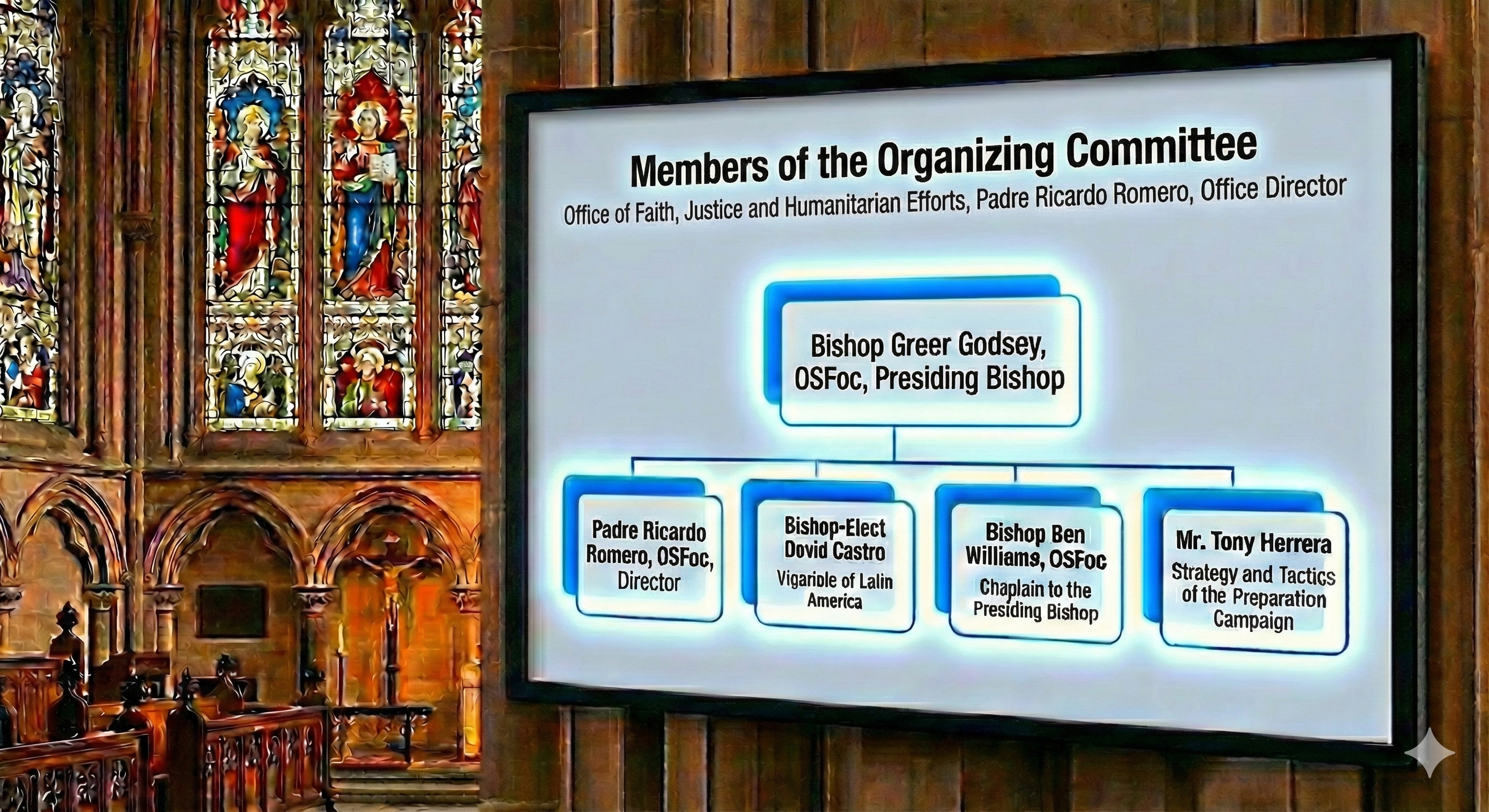
Committee Members
Office of Faith and Justice: Committee Meeting Agenda
Date: February 13, 2026 | Location: Zoom
Presiding: Padre Ricardo Romero, OSFoc, Director
Chaplain: Bishop Ben Williams, OSFoc
I. Call to Order & Opening Prayer
Led by Padre Ricardo Romero
Focus: Discernment in a time of “Emergency Reality.”
II. Item 1: “Standing With Immigrants” – Lenten & Easter Liturgy
Led by Bishop Greer
Discussion on the spiritual witness of the diocese.
III. Item 2: Strategic Review of the Statement of Purpose (SOP)
Contextual Briefing: Padre Ricardo Romero (Data Analysis)
Perspective A (5 mins): Tony Herrera (Modification Proposal)
Perspective B (5 mins): Bishop-Elect Castro (Foundation Analysis)
Open Floor Discussion & Action Item: Vote on SOP Adoption.
IV. Director’s Spiritual Recap
Led by Padre Ricardo Romero
V. Closing Blessing & Prayer
Led by Bishop Ben Williams, Official Chaplain
1. La Agenda
Oficina de Fe y Justicia: Agenda de la Reunión del Comité
Fecha: 13 de febrero de 2026 | Preside: Padre Ricardo Romero, OSFoc, Director
Apertura y Oración Inicial: Padre Ricardo Romero (Enfoque: El discernimiento en una emergencia).
Punto 1: Liturgia “Estando con los Inmigrantes”: Obispo Greer.
Punto 2: Revisión Estratégica de la Declaración de Propósito (SOP):
Los Datos: Informe comparativo por el Padre Ricardo.
Perspectiva A (5 min): Tony Herrera (Modificaciones propuestas).
Perspectiva B (5 min): Obispo-Electo Castro (Alineación con los fundamentos).
Discusión Abierta: Miembros del Comité.
Punto de Acción: Votación formal sobre la adopción del SOP.
Resumen Espiritual del Director: Padre Ricardo.
Bendición Final: Obispo Ben Williams, Capellán Oficial.